

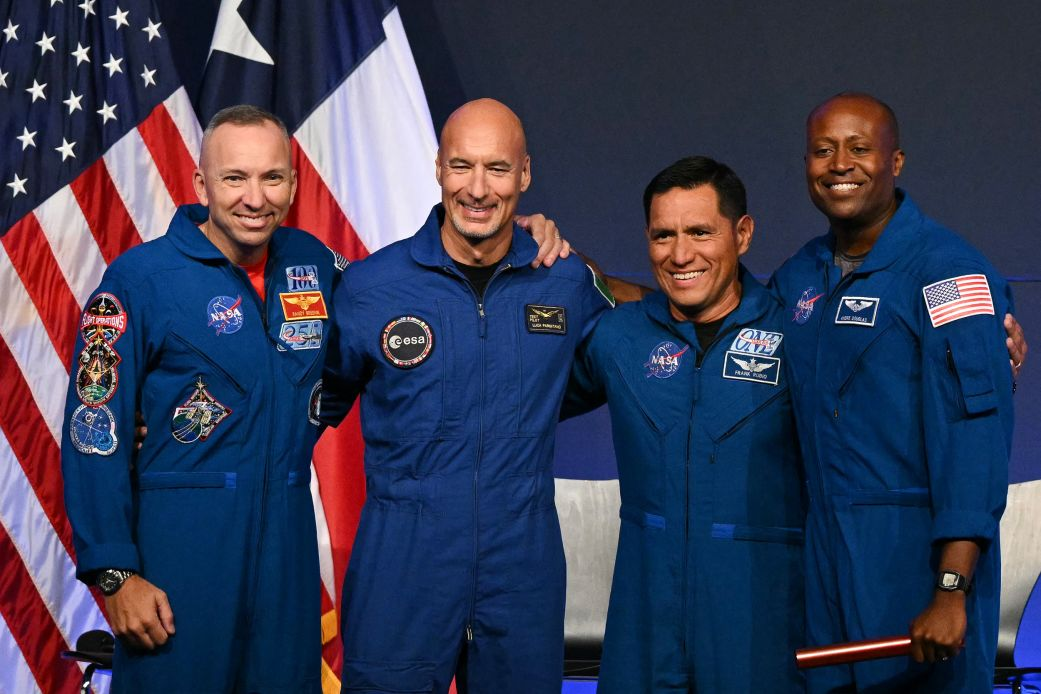
NASA on Tuesday revealed the four astronauts who will join the next Artemis mission — a key, two-week flight that will aim to test out various technologies considered vital to putting astronauts back on the surface of the moon for the first time in more than 50 years.
The crew, set to launch as soon as late 2027, includes three NASA astronauts — first-time space flier Andre Douglas, record-setting astronaut Frank Rubio, and veteran flier and test pilot Randy Bresnik — as well as Italian astronaut Luca Parmitano with the European Space Agency.
Artemis III is designed to serve as a precursor mission to a moon landing, testing out how the NASA-built Orion spacecraft will dock with a lunar lander. The primary goal of the flight, the space agency says, is to “reduce risk” heading into an actual lunar touchdown, which NASA hopes will take place as soon as 2028.In order to reach the moon’s surface, astronauts will have to complete such a move while in lunar orbit. But for Artemis III, NASA is aiming to test the maneuver much closer to home, sticking to low-Earth orbit, or LEO, the area closest to our home planet and the same region where the International Space Station operates.
The Artemis III crew will launch from Florida aboard their Orion capsule, the same type of spacecraft that completed April’s historic Artemis II lunar flyby mission, and hang out in low-Earth orbit.
At least one lunar lander will then launch separately — and it’s not yet clear whether it will be SpaceX’s Starship, Blue Origin’s Blue Moon, or one of each. But upon arrival to low-Earth orbit, the landers would then rendezvous with Orion, allowing the astronauts to dock with the vehicle and potentially climb on board a lander.
NASA has suggested it could carry out the test flight with both Blue Moon and Starship, though it’s not clear how soon either vehicle will be ready. The space agency has made a concerted effort in recent months to spur competition between the companies, which have for years held multibillion-dollar contracts to deliver crew-worthy lunar landers to NASA. Both companies have experienced development setbacks and delays.
During Tuesday’s news conference, NASA chief Jared Isaacman again suggested Artemis III could involve docking with both landers, saying Orion “will rendezvous and dock with the Blue Origin lander, and then again with the SpaceX lander.”
But both SpaceX’s Starship and Blue Origin’s Blue Moon are facing uncertain timelines. Blue Origin in particular encountered a major setback last month when one of the company’s New Glenn rockets exploded during a routine ground test. (New Glenn is the rocket that Blue Origin intends to use to vault the Blue Moon lander to space.)
Isaacman also said NASA plans to carry out a key test — called a wet dress rehearsal — of its Space Launch System rocket, or SLS, by the end of the year.
Tuesday’s announcement marked the rare selection of an all-male crew, which has not been commonplace at NASA for years. Notably, there are several women with military test pilot experience in the agency’s astronaut corps with comparable experience to their male counterparts for a mission like Artemis III.
During an interview with CNN’s Jake Tapper on Tuesday, Bresnik said the lack of women was “not intentional,” and that the astronauts’ boss “had to pick the crew for this flight that he had available, that had the skill sets that he needed.”
“We’ll certainly have female military test pilots — or just other female astronauts — that’ll be picking up on the follow-on Artemis missions, and we’re here to carry the fire so that we can hand off the torch to them,” Bresnik said.
Artemis III comes into view
The Artemis III mission has come together in a uniquely fast-paced and unexpected way.NASA administrator Jared Isaacman stunned the space industry in February by announcing the Artemis III mission plan — usurping previous plans to make Artemis III an actual moon landing, the first since 1972.
Isaacman, however, argued that jumping straight from this year’s Artemis II lunar flyby to a moon landing mission with Artemis III was too big of a technological leap.
“We didn’t go right to Apollo 11,” Isaacman said earlier this year. “We had a whole Mercury Program, Gemini — lots of Apollo missions before we ultimately landed.” NASA’s old Artemis plan, he argued, “was not a pathway to success.”
On Tuesday, NASA gave one of the first substantive descriptions of how the mission might look if it docks with both Blue Origin’s Blue Moon and SpaceX’s Starship.Orion would first dock with Blue Moon, said Artemis program manager Jeremy Parsons, and spend about two days linked up in orbit, allowing astronauts to board the vehicle and evaluate crucial components — including life support systems that Parsons said can only be tested in orbit.
While docked with the Blue Origin vehicle, the astronauts will be able to test a “mass simulator” meant to represent one of the spacesuits that is under development for future moon landing missions by Texas-based company Axiom Space, Parsons told CNN in an interview Tuesday afternoon.
After undocking from the Blue Origin lander, the Orion spacecraft would then dock with SpaceX’s Starship for only “about a day,” Parsons said.
Parsons added that the Artemis III crew would not enter the SpaceX vehicle during the mission, as it will not be outfitted with a life support system or a built-out interior.“Their crew cabin is coming along later in their development cycle,” Parsons told CNN, noting that SpaceX has previously built a crew-worthy cabin on its Dragon spacecraft that allows NASA to “buy down” some of those risks when it comes to Starship.
The trip would conclude with a splashdown landing in the Pacific Ocean.
Meet the Artemis III astronauts
Bresnik, Douglas, Rubio and Parmitano will have about one year to prepare for the flight under the current timeline. For comparison, NASA’s Artemis II astronauts trained for three years for their mission, in part due to a string of schedule delays.The four men who make up the Artemis III crew have a range of backgrounds, with a heavy emphasis on engineering and test pilot experience.
“NASA’s crew assignments are determined by a variety of factors, including upcoming mission needs, required training timelines, crew availability, mission-specific technical requirements, and the skillsets and experience of astronauts eligible for assignment,” a NASA spokesperson said of crew selection process and the lack of women among the group, in a statement.
“These four astronauts were best suited for this mission profile given the demands of additional missions.”
Randy Bresnik
Bresnik, 58, nicknamed “Komrade,” joined NASA in 2004. He’s flown missions on NASA’s space shuttle and Russia’s Soyuz capsule in 2009 and 2017, respectively. And he’s played a key role in the Artemis program already, serving as assistant-to-the-chief astronaut. In that role, Bresnik “manages insight and expertise of the crew in their essential role in the development and testing of all vehicles and aspects of an Artemis mission,” according to NASA.Bresnik will serve as commander of the Artemis III flight.“We are certainly humbled as a crew to be able to be your crew that executes this Artemis III mission in space, being that unifying link between the phenomenal Artemis II mission we just had two months ago and the Artemis IV mission that will follow ours, where we will again be the first to land humans on another celestial body — that celestial body being our neighbor in the sky at night, the moon,” Bresnik said.
Bresnik considers Santa Monica, California, his hometown. Before joining NASA, he studied mathematics at The Citadel military college in South Carolina. He also has a master’s degree in aviation systems from the University of Tennessee-Knoxville and graduated from Air War College in 2008. A retired officer in the United States Marine Corps, Bresnik also attended the U.S. Naval Test Pilot’s School — a common astronaut career path — to become an F/A-18 Test Pilot and served in Operation Iraqi Freedom.
Andre Douglas
Douglas, 40, joined NASA in 2021. He has never before been assigned to a mission, but he did train as backup for the Artemis II mission, which in April made history by carrying four astronauts on a trip around the moon — marking the first time humans have ventured to the vicinity of the moon since the Apollo program ended more than 50 years ago.