
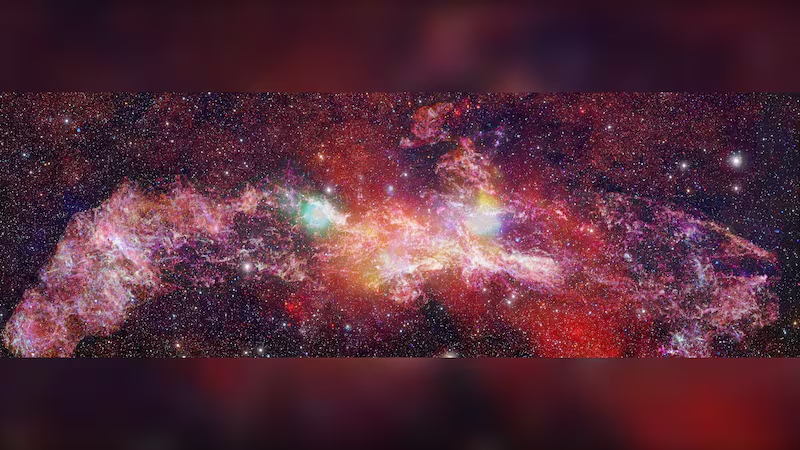
Astronomers have made a breakthrough discovery by detecting the long-sought “wind” blowing from the supermassive black hole at the center of the Milky Way galaxy, ending a scientific mystery that has persisted for more than five decades.
The black hole, known as Sagittarius A*, sits approximately 26,000 light-years from Earth and contains a mass more than four million times that of the Sun. While scientists had long suspected it emitted powerful winds, direct evidence had remained elusive.
Using observations from advanced telescopes, researchers identified a giant cone-shaped cavity filled with hot gas near the black hole. The structure appears to have been carved out by a steady outflow of material originating from Sagittarius A*, providing the clearest evidence yet that the black hole is actively influencing its surroundings.
Interestingly, the newly discovered wind is not the violent cosmic hurricane many scientists expected. Instead, researchers describe it as a relatively gentle but persistent breeze capable of shaping the environment around the galaxy’s center over long periods.
The discovery offers astronomers a rare glimpse into how relatively quiet supermassive black holes behave and how they affect the formation and evolution of stars and galaxies.
Scientists say the finding could help answer broader questions about the role black holes play in regulating galactic ecosystems throughout the universe.