
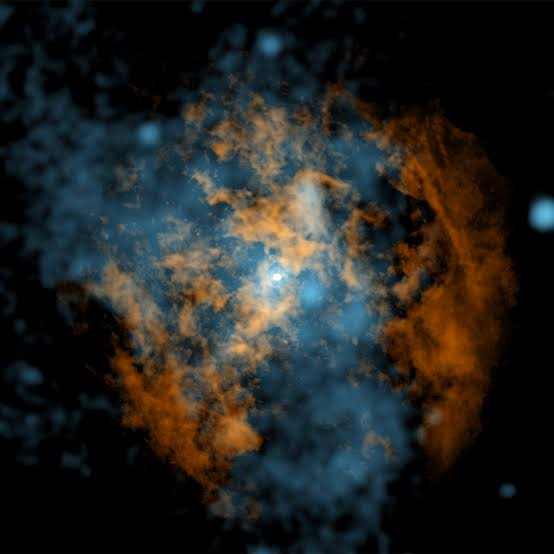
Astronomers have uncovered new evidence that may solve one of the biggest mysteries surrounding the supermassive black hole at the center of the Milky Way, revealing signs of a long-sought cosmic wind that appears to have been missing for decades.
The black hole, known as Sagittarius A*, has long puzzled scientists because of its unusually quiet behavior. Unlike the highly active black holes found in many other galaxies, Sagittarius A* consumes relatively little matter and emits far less energy than researchers would expect from an object containing roughly four million times the mass of the Sun.
Now, a team of researchers studying the region around the black hole has identified evidence suggesting that powerful winds are carrying away much of the gas that would otherwise be pulled into the black hole. The discovery helps explain why Sagittarius A* appears so calm despite being surrounded by material that could potentially fuel more dramatic activity.
According to scientists, these outflows act like a cosmic escape valve, ejecting gas and energy back into space before it can fall into the black hole. This process limits the amount of material available for accretion, effectively starving the black hole and reducing its brightness.
The findings offer important insights into how black holes interact with their environments and how they influence the evolution of galaxies over billions of years. Researchers believe similar winds may exist around other black holes throughout the universe, shaping the formation of stars and regulating the growth of galactic structures.
Astronomers used advanced observations and computer simulations to trace the movement of matter near Sagittarius A*, allowing them to identify patterns consistent with a powerful outflow. The results provide some of the strongest evidence yet that the Milky Way’s central black hole is actively expelling material rather than simply consuming everything in its path.
The discovery comes amid a golden era of black hole research, following groundbreaking achievements such as the first-ever images of black holes captured by the Event Horizon Telescope and increasingly detailed observations from next-generation space observatories.
Scientists say understanding Sagittarius A* is particularly important because it offers a unique opportunity to study a supermassive black hole up close. Located approximately 26,000 light-years from Earth, it serves as the closest laboratory for investigating some of the most extreme environments in the universe.
The findings could also help answer broader questions about why some black holes become intensely active while others remain relatively dormant for long periods.
As researchers continue to probe the heart of our galaxy, the latest discovery provides a clearer picture of the hidden forces shaping the Milky Way and reveals that even the universe’s quietest giants may be far more dynamic than they appear.