
For decades, Nike has sold shoes on the promise that they could help buyers to run faster and farther, jump higher, or even just look a little cooler. This year, the sportswear giant has made its most ambitious pledge yet: to alter minds.
Its Mind shoe range has captured imaginations around the globe since hitting the market in January, rapidly selling out across repeated worldwide releases with buyers eager to get their hands on Nike’s first foray into “neuroscience-based footwear.”
In an age of booming growth for smartwatches, fitness trackers and other wearable technologies, it’s an example of a new category of products promising a range of wellness benefits — from better posture to smoother skin — through innovations in apparel, rather than electronic add-ons.
Sensory technology company Naboso incorporates a specialized texture into insoles and socks that, like Nike Mind, aims to stimulate sensory nerves on the foot. It claims to have benefits including improved balance and posture, better circulation and support for emotional regulation.
“Wearable wellness” brand Cean launched a specialized fabric in 2025, incorporated into its line of compression wear to act as a “wearable lymphatic massage.” French brand Coperni promises to deliver a wealth of skincare benefits via its “regenerating” garments that release probiotics and prebiotics to the skin’s surface.
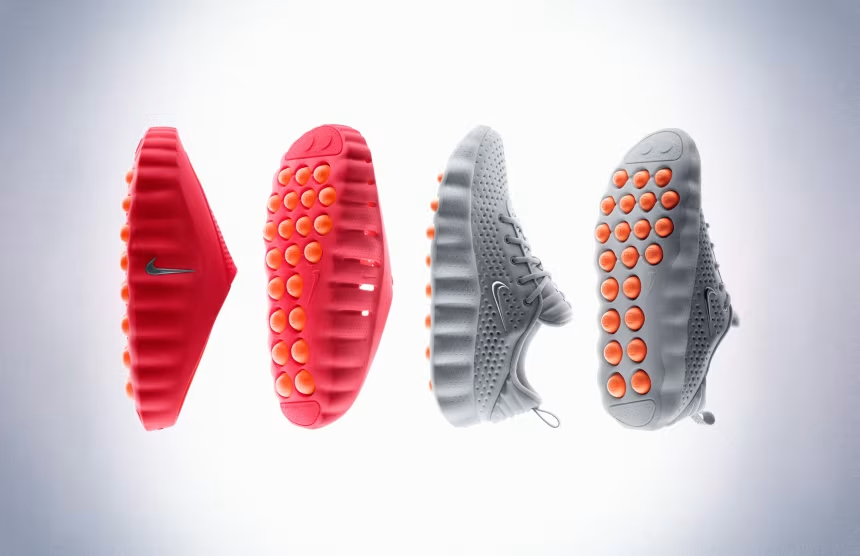
But when it comes to mass market appeal, Nike’s Mind shoes are steps ahead. Coming in both mule and sneaker shapes, as well as men’s and women’s versions, they are billed as being engineered to remove mental distractions and boost focus.
That they are designed purely to be worn before and after competition — rather than during exercise — has not deterred buyers. With the two styles retailing at $95 and $145 respectively, Nike said more than two million people signed up for restock notifications on the company’s online shop after the mules sold out on launch.
Listings have appeared on resale sites for substantially marked-up fees, with the Light Smoke Grey version of the mule highlighted as Nike’s No. 1 shoe release ever on StockX, an online secondary marketplace that launched in 2016.

The Nike Mind was released in January 2026. Nike
‘Relaxed alertness’
The key to Nike’s “mind-altering” claim is 22 foam nodes spread across the bottom of each shoe. When the wearer treads on the ground the nodes move independently like pistons to press up against the foot’s mechanoreceptors, sensory neurons responsible for identifying sensations like pressure and texture.
Nike says that during 10 years of development, neuroscientists measured athletes’ brainwaves before, during and after walking on treadmills wearing the Mind shoes.
Results showed increased electrical activity in the area of the brain associated with the Sensorimotor Network (SMN), a system that forms the main driver for movement, touch and sensation, Nike said. Its activation directly “tunes down” the Default Mode Network (DMN), it continued, the network responsible for self-referential thinking and general mind wandering.

Norwegian soccer superstar Erling Haaland was among the athletes that Nike says tested the Mind footwear. Nike
As a result, wearers can, theoretically, shift thoughts away from “negative feedback loops” and into what Graeme Moffat, principal researcher at Nike Sport Research Lab, describes as a state of “relaxed alertness.” Nike has not yet published peer-reviewed research on the science behind the shoes.
“Nike Mind opens the door to a whole new category of sensory-optimized footwear,” Moffat said in a press release.
“We’re trying to help you really engage with new sensory experiences, focus on your intention, and get out of your head.”
Old concepts, new trends
Is mind-altering footwear simply too good to be true? Not necessarily, says Dr. Ishara Dharmasena, a professor of smart textiles and wearable technologies at the UK’s Loughborough University.
Born in Sri Lanka, Dharmasena sees the Nike Mind shoes as a science-based approach to concepts that have existed in the Ayurvedic and traditional medicines of his homeland for thousands of years, with massages (Pada Abhyanga) promoting relaxation and reduced stress through the targeting of specific foot areas.
The theory of the foam nodes firing up mechanoreceptors and subsequently stimulating parts of the brain is not dissimilar to the process of meditation, he explains, whereby the mind is actively encouraged to think about what is happening within the body.
“You think about this new sensation that helps you to keep the alertness or awareness about your body,” Dharmasena told CNN.
“It stops you from drifting off, and it gives you a better sensation about where you are, which means it helps you to have a feeling about yourself or your location much better than a normal, conventional footwear. So, scientifically, it does have some valid points.”
He does offer some caveats. Chief among them is his theory that any benefits could fade in the long term as wearers gradually adjust to the sensations.
“As you wear it more and more, as the neurons are firing more and more, what our brain naturally does is levers that off, because it has to be alert to other sensations coming in for your own safety,” Dharmasena said.
He adds that “the fact you are getting sensation doesn’t necessarily mean your cognitive functions are better.”
He classifies the shoe as a “passive neuro-wearable,” a new class of product that bucks the recent surge in wearable technologies, like smartwatches, that rely on battery power to track performance data. He sees it as part of a wider category of sports and fitness smart textiles that feel like typical sportswear.
The global smart textiles market was expected to surpass $5.55 billion by 2025, according to a study published last year.
“It’s kind of like an anti-trend,” Dharmasena said of Nike Mind. “Because the world is going towards electronics, whereas they are going towards a clever passive mechanism which does not think of metrics but more the relaxation of athletes.”
ByJack Bantock(CNN)