

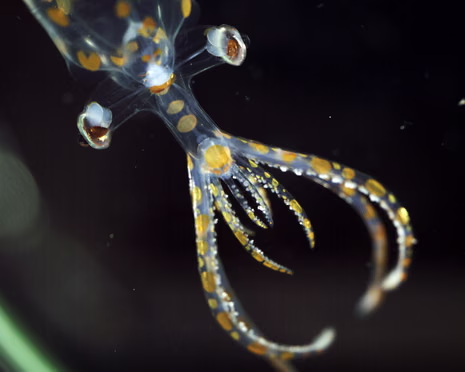
An international team of marine scientists has discovered 31 previously unknown marine species during a two-week scientific expedition exploring one of the least understood regions of Earth’s oceans, highlighting just how much of the deep sea remains unexplored.
The expedition, conducted aboard the state-of-the-art research vessel Falkor (too) off the coast of Brazil, brought together researchers from the United States, Brazil, Australia, and Japan to investigate the ocean’s mysterious midwater zone—a vast ecosystem that plays a crucial role in regulating Earth’s climate.
Using advanced underwater imaging systems, genetic sequencing technology, and a cutting-edge 3D confocal microscope capable of analysing living organisms in real time, scientists were able to identify new species at an unprecedented pace.
Among the newly discovered organisms are several species of jellyfish, comb jellies, siphonophores, amphipods, larvaceans, and giant single-celled rhizarians. Researchers believe many of these creatures have never before been observed by humans and may possess unique biological characteristics that could improve scientific understanding of marine ecosystems.
Expedition leader Dr. Karen Osborn described the findings as evidence that the ocean’s midwater remains one of the most biologically diverse yet least explored habitats on Earth.
Scientists explained that many organisms living in this region migrate vertically every night, transporting massive amounts of carbon from the ocean’s surface into deeper waters. This natural process helps regulate atmospheric carbon dioxide levels and plays a significant role in mitigating climate change. Understanding these species could therefore improve future climate models.
Researchers also noted that the expedition demonstrates how advances in imaging technology and onboard genetic analysis are dramatically accelerating the discovery of new marine life, allowing scientists to identify species in hours rather than waiting months for laboratory analysis.
Marine biologists estimate that millions of ocean species remain undiscovered, particularly in deep-water ecosystems that are difficult to access. They argue that continued investment in ocean exploration is essential not only for biodiversity conservation but also for discovering new medicines, biological compounds, and technologies inspired by marine organisms.
The discovery comes as scientists continue to stress the importance of protecting the world’s oceans from climate change, pollution, and overfishing. Experts say documenting marine biodiversity is becoming increasingly urgent as human activity continues to alter ocean environments.
The findings provide another reminder that despite centuries of exploration, much of Earth’s largest habitat remains largely unknown, with countless new species still waiting to be discovered beneath the waves.