

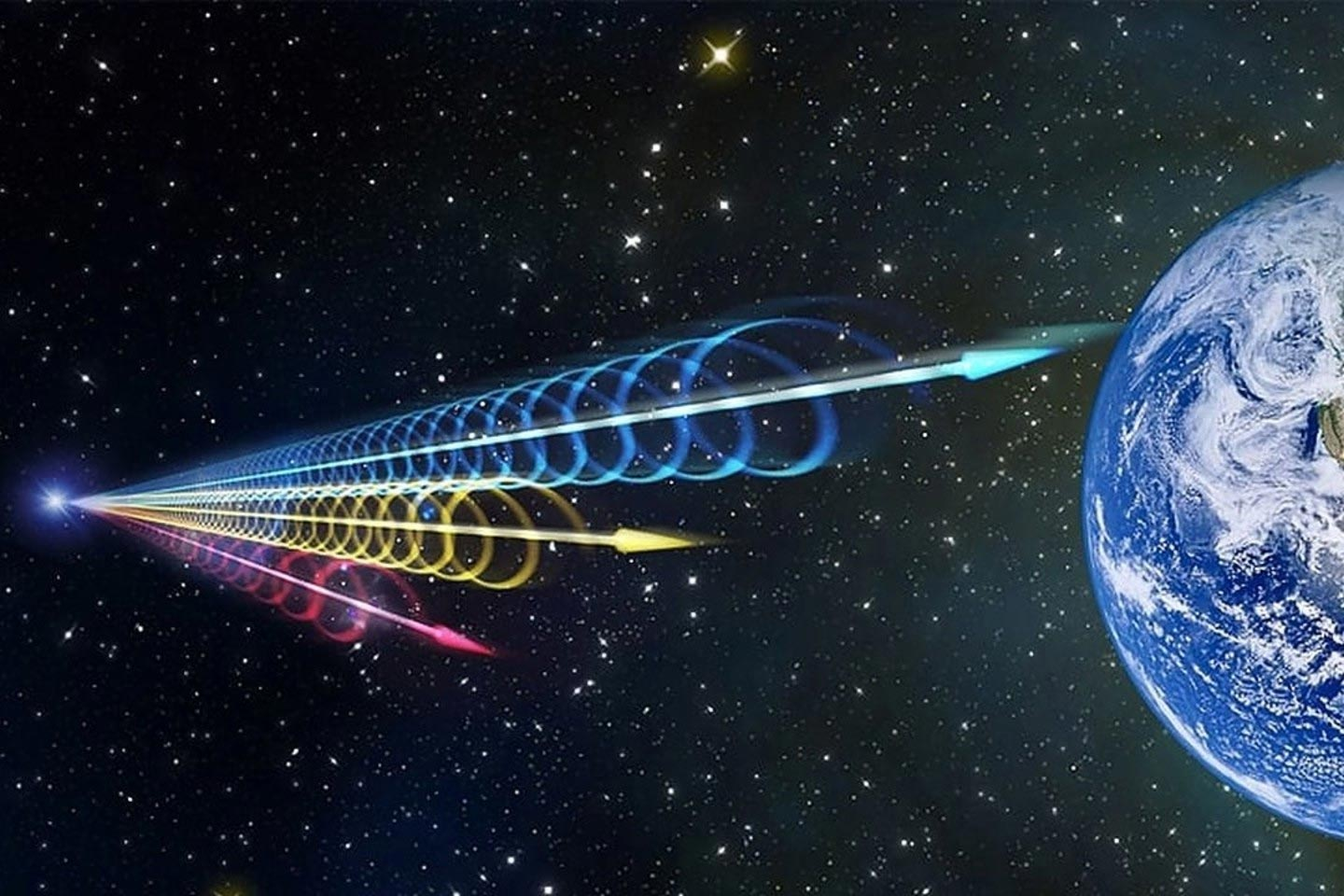
An international team of astronomers has uncovered new evidence that could help explain one of the universe’s most mysterious phenomena: Fast Radio Bursts (FRBs).
FRBs are extremely powerful bursts of radio waves that originate from distant galaxies and last only a fraction of a second. Despite their brief duration, each burst can release as much energy as the Sun emits over several days, making them one of the most intriguing puzzles in modern astronomy.
Using observations from some of the world’s most advanced radio telescopes, researchers were able to trace several newly detected FRBs back to their host galaxies. The findings suggest that many of these bursts may be linked to highly magnetized neutron stars known as magnetars, which are among the most extreme objects in the universe.
Scientists say the discovery strengthens the theory that magnetars play a central role in producing FRBs. However, researchers also found evidence that some bursts may originate from entirely different cosmic environments, indicating that multiple mechanisms could be responsible for generating the mysterious signals.
The study provides astronomers with valuable new data that could help them understand how matter behaves under extreme conditions and how galaxies evolve over billions of years.
Researchers believe future observatories, including next-generation radio telescope arrays, will enable them to detect thousands of additional FRBs and uncover even more information about their origins.
The discovery is being hailed as an important step toward solving one of astronomy’s biggest mysteries and demonstrates how advances in telescope technology continue to expand humanity’s understanding of the cosmos.
Scientists say that while many questions remain unanswered, each new detection brings them closer to understanding the powerful events occurring in distant corners of the universe.