
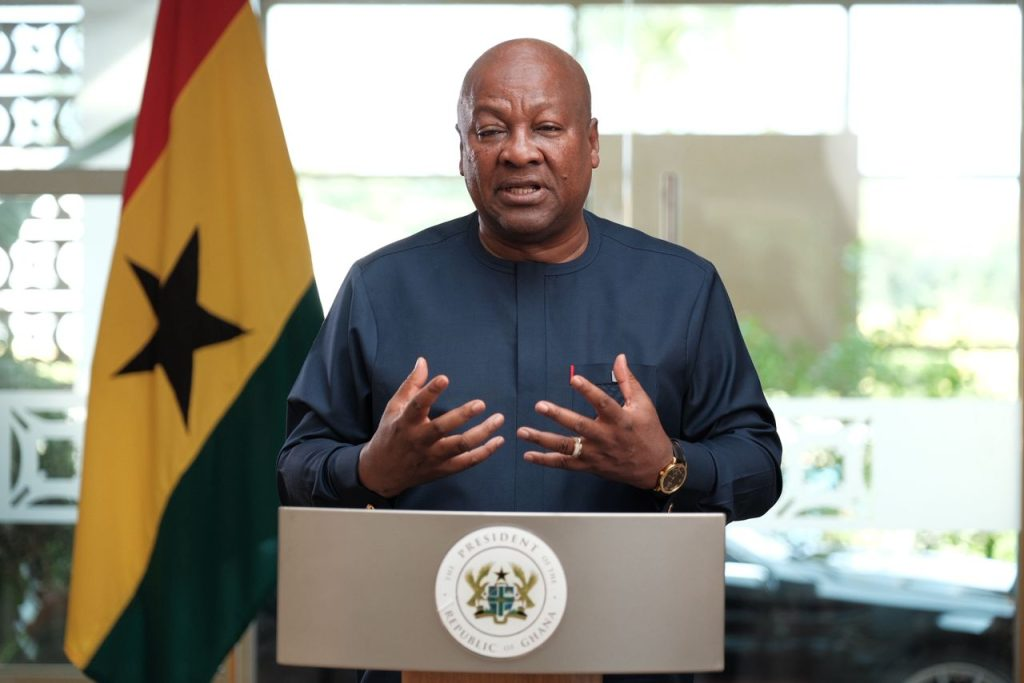
President John Dramani Mahama has attributed Monday’s devastating floods in Accra to a combination of increasingly extreme weather driven by climate change and persistent human encroachment on waterways, warning that the country must confront both challenges to prevent future disasters.
Speaking after widespread flooding submerged roads, homes, businesses, and vehicles across parts of the capital, the President revealed that preliminary data showed approximately 140 millimeters of rainfall fell on Accra during the downpour—making it one of the heaviest rainfall events experienced in several years.
According to President Mahama, the volume of rainfall far exceeded recent records, noting that the highest single-day rainfall recorded in the previous year was only about 56 millimetres.
“The amount of rainfall recorded today is among the highest experienced in several years. Preliminary data indicates that approximately 140 millimeters of rain fell on Accra. By comparison, the highest single-day rainfall recorded last year was about 56 millimeters,” the President stated.
He explained that while the intensity of the rainfall reflects the growing impact of climate change, which is beyond human control, the extent of the destruction was significantly worsened by human activities that continue to obstruct the natural flow of water.
President Mahama criticized the construction of buildings on waterways, the blocking of drainage channels, and other environmentally harmful practices, saying these actions have increased the vulnerability of communities to flooding whenever heavy rains occur.
“That aspect of the problem is beyond our control because it is driven by changing climatic conditions. There is the issue of human behavior,” he said.
The President stressed that successive governments often face public criticism whenever efforts are made to demolish structures illegally built along rivers, wetlands, and drainage corridors. However, he argued that such enforcement measures are necessary to protect lives and property.
“Whenever government begins removing structures built in waterways, some people accuse us of being inhumane. Yet when disasters such as today’s flooding occur, the consequences affect everyone. The irresponsible actions of a few individuals end up putting entire communities at risk,” he added.
President Mahama assured residents that government would continue implementing flood mitigation measures, including the desilting and expansion of drains, enforcement of planning regulations, and the removal of structures obstructing waterways where necessary.
He also called on Metropolitan, Municipal and District Assemblies, traditional authorities, developers, and residents to work together to ensure that drainage systems remain free from refuse and illegal construction.
Environmental experts have long warned that rapid urbanization, weak enforcement of planning laws, indiscriminate waste disposal, and climate change are contributing to increasingly severe flooding across Ghana’s major cities.
Monday’s floods left several communities in Accra under water, with vehicles submerged, homes inundated, businesses damaged, and thousands of commuters stranded for hours as major roads became impassable.
As emergency response teams continue to assess the damage and assist affected communities, President Mahama urged Ghanaians to support government efforts to restore environmental discipline, warning that without collective action, flooding incidents are likely to become more frequent and more destructive in the years ahead.